
Baccarat is one of the most played casino table games in the world. It carries a reputation as a high-stakes game, but its actual mechanics are among the simplest in any casino. You make one decision before each round, then the hand plays out automatically according to fixed drawing rules. This guide covers full baccarat rules, card values, the house edge on all three bets, and what to know before playing on SkyExchange. Players interested in other games can find full guides in Casino Games Explained.
The Objective of Baccarat
The objective of baccarat is to predict which of two hands, the Player hand or the Banker hand, will have a total value closest to nine after all cards are dealt. A third outcome, the Tie, is also available as a betting option.
The names Player and Banker do not refer to the person placing the bet and the casino. They are simply the names of the two hands dealt in each round, and any bettor can wager on either hand regardless of their position at the table.
Baccarat is entirely a prediction game with no decisions available after the bet is placed. Once a bet is confirmed, the cards are dealt and the hand resolves according to fixed rules that apply automatically. There is nothing a player can do to influence the outcome of a round once betting closes.
Card Values in Baccarat
Baccarat uses a unique card valuation system that differs from most other card games:
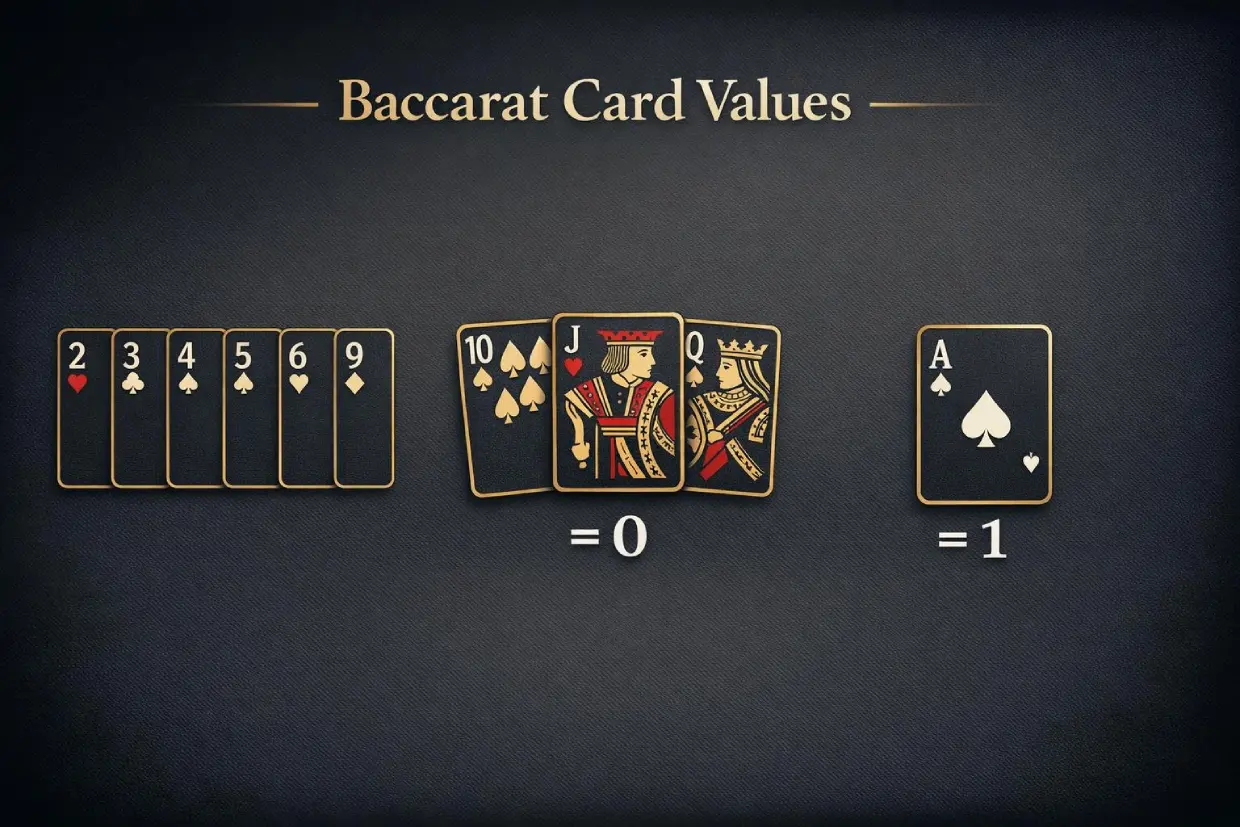
- Cards 2-9 are worth their face value
- Tens, Jacks, Queens, Kings are worth zero
- Aces are worth one
The total value of a baccarat hand is calculated by adding the values of the cards and taking only the rightmost digit of the result. This means a hand can never exceed nine in value.
How Baccarat Hand Totals Work
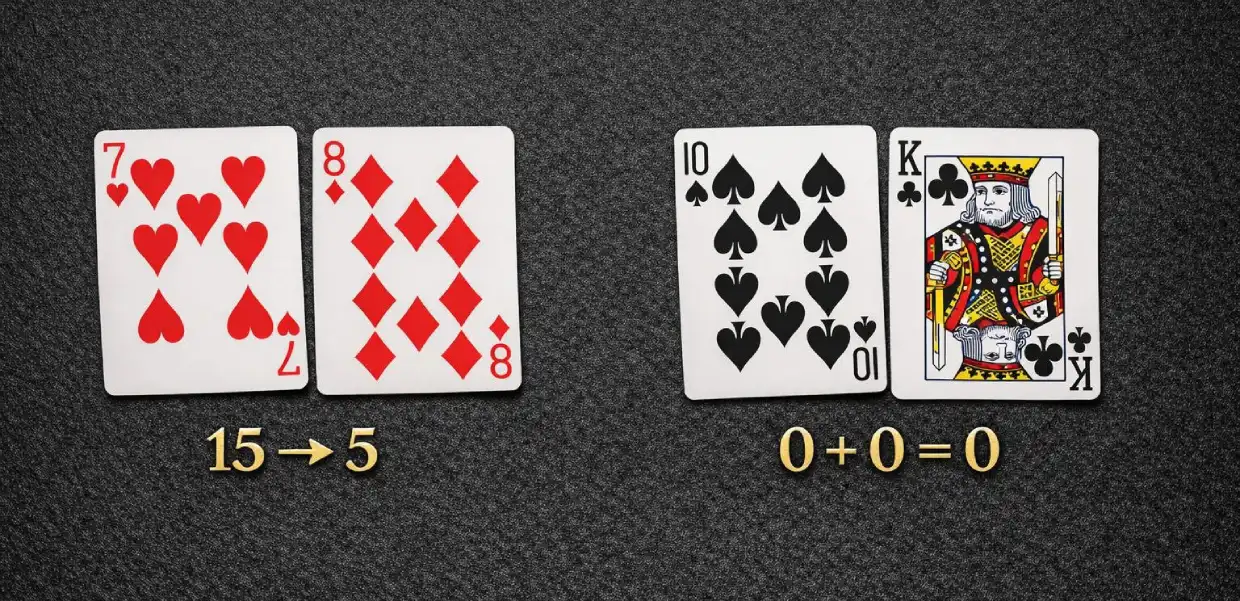
A hand containing a seven and an eight totals fifteen, but the baccarat value of that hand is five, not fifteen. A hand containing two tens totals zero because both cards are worth zero.
The strongest possible hand in baccarat is a natural nine, followed by a natural eight. A natural is a two-card total of eight or nine dealt on the initial draw. When either the Player or Banker hand is dealt a natural, no further cards are drawn and the round resolves immediately.
Baccarat Drawing Rules
The drawing rules determine whether a third card is dealt to the Player hand, the Banker hand, or both. These rules are fixed and applied automatically by the dealer with no player input. Understanding them is not strictly necessary to play, but it provides useful context for why rounds resolve the way they do.
Player Hand Drawing Rules
- Total of 0-5: Player draws a third card
- Total of 6-7: Player stands
- Total of 8-9: Natural declared, no further cards for either hand
Banker Hand Drawing Rules
The Banker hand rules are more complex and depend on the Banker’s two-card total combined with the value of the Player’s third card (if one was drawn):
- When the Player stands (no third card drawn): Banker draws on totals of 0-5 and stands on 6 or above
- When the Player draws a third card: Banker’s decision to draw or stand depends on a specific matrix of combinations between the Banker total and the Player’s third card value
The practical effect of these drawing rules is to give the Banker hand a marginal statistical advantage over the Player hand in the long run. This is reflected in the commission structure on winning Banker bets.
The Three Baccarat Bets
Baccarat offers three betting options for each round. Understanding the house edge on each is the most practically valuable knowledge a baccarat player can have.
The Banker Bet
A wager that the Banker hand will have a total closer to nine. Because the Banker drawing rules give the Banker hand a slight mathematical advantage, the Banker bet wins more often than the Player bet over a large number of rounds. To account for this, winning Banker bets are subject to a five percent commission. After deducting this commission, the Banker bet carries a house edge of approximately 1.06%, making it one of the lowest house edge bets available across all casino games. These figures are consistent with long-term hold percentage data tracked by the UNLV Center for Gaming Research.
The Player Bet
A wager that the Player hand will have a total closer to nine. It pays even money with no commission deducted from winning bets. The house edge on the Player bet is approximately 1.24%, marginally higher than the Banker bet due to the statistical advantage of the Banker drawing rules. Both the Banker and Player bets are among the most player-friendly wagers in any casino game.
The Tie Bet
A wager that both hands will finish with identical totals. It pays at eight to one, which appears attractive given the payout level. However, the probability of a tie occurring is low enough that the house edge on the Tie bet is approximately 14.4%. This is dramatically higher than either the Banker or Player bet. Most experienced baccarat players treat the Tie bet as an option to avoid entirely regardless of how appealing the payout appears.
Baccarat Bets Compared
| Banker Bet | Player Bet | Tie Bet | |
|---|---|---|---|
| Payout | 1:1 (minus 5% commission) | 1:1 | 8:1 |
| House Edge | 1.06% ⚡ | 1.24% | 14.4% ❌ |
| Commission | 5% on wins | None ✅ | None |
| Win Frequency | Highest | Slightly lower | Rare |
| Recommended | ✅ Best mathematical bet | ✅ Good alternative | ❌ Avoid |
Baccarat Strategy
Baccarat strategy is straightforward precisely because player decisions are limited to a single bet choice per round. There are no cards to manage, no drawing decisions to make, and no complex situational judgments required.
Bet on the Banker Consistently
Betting on the Banker is the mathematically optimal approach to baccarat. The lower house edge means that over a large number of rounds, the Banker bet loses money more slowly than the Player bet, and both lose money far more slowly than the Tie bet. Players who want the best mathematical foundation for a baccarat session should place the majority of their bets on the Banker.
Avoid the Tie Bet
The Tie bet’s house edge is so significantly higher than the other two options that placing it consistently would accelerate losses at a rate that cannot be justified by the appeal of the eight to one payout. Tie bets occur infrequently enough that the enhanced payout does not compensate for the probability of losing.
Betting Systems Do Not Change the House Edge
Betting systems such as the Martingale or Fibonacci are sometimes discussed in relation to baccarat, but they do not change the house edge on any bet. They alter the distribution of wins and losses across a session but cannot produce a long-term mathematical advantage where none exists in the underlying game. Understanding this prevents players from placing excessive confidence in systems that may produce short-term results but cannot sustain them indefinitely.
Live Baccarat

Live baccarat is one of the most actively played live casino formats globally and particularly popular across Asian markets including India. A real dealer manages the dealing sequence in real time via video stream, with players placing their bets through the platform interface during the betting window before each round.
The dealing sequence, drawing rules, and payout structure are identical to the standard digital game.
Scoreboards and Pattern Tracking
Live baccarat tables often feature additional information displays showing recent hand results, streaks of consecutive Banker or Player wins, and road maps that track patterns across recent rounds. These displays are provided as a visual aid for players who follow baccarat trends as part of their session approach.
Past results have no influence on future rounds in baccarat. Each hand is dealt from a freshly shuffled or continuously shuffled shoe and is statistically independent of all previous hands.
Squeeze Baccarat
Squeeze baccarat is a live variant where the dealer slowly reveals the cards by bending and peeling them to build anticipation around the result. It adds a theatrical element to the reveal without changing any of the rules or probabilities of the base game. Players who find the standard live format too fast-paced will find squeeze baccarat offers a more considered rhythm within the same betting structure.
Common Baccarat Mistakes to Avoid
New baccarat players often fall into patterns that cost them money unnecessarily. Knowing what to watch out for makes a real difference over time.
- Chasing the Tie bet for the payout. The 8:1 return looks tempting, but with a 14.4% house edge you are paying heavily for that excitement. Stick with Banker or Player.
- Following streaks as if they predict future results. Scoreboards at live tables display past outcomes, but each round is independent. A run of six Banker wins does not make a seventh more or less likely.
- Switching bets every round based on gut feeling. Jumping between Banker, Player, and Tie without a consistent approach increases your exposure to the higher-edge bets. Picking Banker and staying there is the simplest winning formula.
- Ignoring the 5% commission on Banker wins. The Banker bet is still the best option even after commission, but factor it into your session planning so your bankroll calculations are accurate.
- Playing without a stop-loss. Baccarat rounds move fast, especially online. Set a loss limit before you start and walk away when you hit it. The house edge is small but it compounds over hundreds of hands.
FAQ About Baccarat
What is the best bet in baccarat?
The Banker bet has the lowest house edge at 1.06% after the 5% commission. It is the mathematically strongest option for every round.