
Volatility is the number that tells you how a slot actually behaves during play. Two games can have identical RTPs and deliver completely different experiences because one pays small amounts frequently while the other pays large amounts rarely. Volatility describes this difference. Understanding it is essential for choosing games that match your budget and for setting realistic expectations about any session. This guide covers what volatility measures, how it affects your results, and how to use it when picking slots on SkyExchange. For a broader view of how casino game mechanics work, the full How Online Casino Games Work guide covers the fundamentals.
What Volatility Measures
Volatility quantifies the spread of outcomes around the expected average return. It answers one question: how much will your results vary from spin to spin?
Low Volatility
Outcomes cluster close to the average. Small wins appear regularly, the balance moves predictably, and losing streaks are short. You rarely win big, but you rarely lose fast either.
High Volatility
Outcomes deviate widely from the average. Extended periods of minimal return are punctuated by infrequent but potentially very large payouts. Your balance swings dramatically within a single session.
The Key Distinction
Volatility does not affect the long-run expected return. A high-volatility slot and a low-volatility slot with identical RTPs return the same theoretical percentage over millions of rounds. The difference is entirely in how that return is distributed across individual spins and sessions.
The underlying statistical concept is standard deviation. High volatility means a wide standard deviation around the mean return. Low volatility means a narrow one. For practical purposes this translates directly into: how often you win, how much you win when you do, and how much your balance moves between wins. The What Is RTP guide explains why RTP alone is not enough to understand how a slot will behave, and volatility is the dimension that completes the picture.
The Volatility Spectrum
Slot volatility is most commonly classified across three tiers. The classification is not standardised across the industry, but the underlying distinctions are consistent.
Low Volatility Slots
- Wins on a high proportion of spins
- Individual wins are small, often returning less than the stake
- Range between smallest and largest wins is narrow
- Balance trajectory across a session is relatively stable
- Losing streaks are short
- Best for: limited session budgets or players who prefer steady play over big swings
Medium Volatility Slots
- Moderate win frequency with more varied payout sizes
- Bonus features produce more meaningful returns than in low-volatility designs
- Balance moves but not dramatically in either direction
- Broadest category of mainstream slot releases
- Best for: most players who want a balance between regular wins and occasional bigger payouts
High Volatility Slots
- Wins are infrequent
- Many spins return nothing or minimal amounts
- Return is heavily concentrated in bonus features that trigger rarely but pay substantially
- Balance drops steadily then spikes when a feature hits
- Maximum win potential is much higher than low or medium designs
- Best for: larger session budgets and players motivated by big payout potential over session length
Volatility Comparison Table
| Low Volatility | Medium Volatility | High Volatility | |
|---|---|---|---|
| Win Frequency | High ✅ | Moderate | Low |
| Average Win Size | Small | Medium | Large ⚡ |
| Losing Streaks | Short ✅ | Moderate | Long |
| Max Win Potential | Low | Medium | Very High ⚡ |
| Balance Stability | Stable ✅ | Mixed | Volatile |
| Bonus Feature Impact | Minor | Moderate | Major ⚡ |
| Best Budget Ratio | 30-50x stake | 50-100x stake | 100-200x+ stake |
| Session Risk | Low ✅ | Medium | High |

Some developers add a very high or extreme volatility tier for slots engineered specifically around maximum payout potential, with multipliers reaching 50,000x the stake or higher. These games accept the near-certainty of a losing session for most players in exchange for the possibility of a transformative outcome.
How Volatility Is Built Into Game Design
Volatility is not a single setting. It emerges from the combination of several mathematical and mechanical choices made by the developer. Understanding these explains why two games can feel completely different even when their surface parameters look similar.
Paytable Structure
A paytable with a large gap between lowest and highest-paying combinations produces higher volatility. If the top symbol pays 1,000x the stake while mid-tier symbols pay 2-3x, the game’s return is concentrated in rare top hits. A paytable where all combinations pay within a narrow range produces lower volatility because wins are more evenly distributed.
Win Frequency and Paytable Range
These two factors work together:
- High win frequency + narrow paytable = low volatility (wins are common and similar in size)
- Low win frequency + wide paytable = high volatility (wins are rare but potentially very large)
Neither factor alone defines volatility. Both dimensions together create the game’s volatility character.
Bonus Feature Contribution
This is one of the most significant but least discussed drivers of slot volatility. Two things matter:
- What percentage of total RTP is delivered through the bonus feature (higher % = higher volatility)
- How frequently the bonus triggers (less frequent = higher volatility)
A game delivering 70% of its RTP through free spins triggering every 200 base spins produces dramatically more variance than one delivering 30% through a bonus triggering every 50 spins, even at the same headline RTP. The full mechanics of how bonus features integrate into slot mathematics are covered in How Slot Machines Work.
Reel Mechanics That Amplify Volatility
Certain mechanics create paths to very large wins from a single spin:
- Cascading/tumbling reels that chain multiple wins within one round with growing multipliers
- Expanding wilds that cover entire reels during bonus rounds
- Sticky wild accumulation that builds over multiple free spins
- High-multiplier bonus rounds that can multiply wins by 10x, 50x, or more
These mechanics all open large upside potential without proportionally increasing win frequency. The gap between a spin with one cascade and one with eight consecutive cascades is vast, which is exactly what drives high volatility.
Volatility and RTP Working Together
The interaction between volatility and RTP has direct consequences for session outcomes that RTP alone does not capture.
The Session Budget Problem
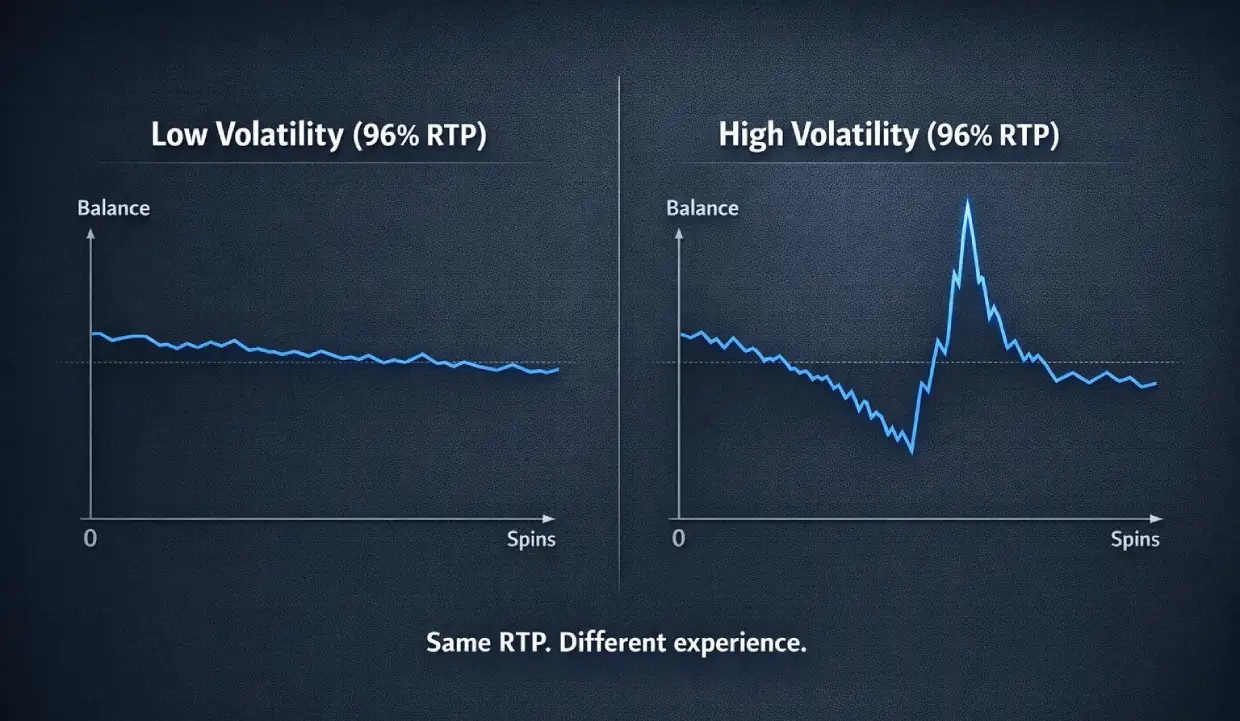
For a fixed budget and fixed stake, a high-volatility game carries a significantly higher probability of losing your full budget before a meaningful win occurs, compared to a low-volatility game with the same RTP.
Example: A session budget of 50 units at a 1-unit stake. The theoretical expected loss across 50 rounds at 96% RTP is 2 units. But on a high-volatility game, the actual result can range from losing all 50 units to returning several hundred units. On a low-volatility game with the same RTP, the result clusters much closer to that 2-unit expected loss.
The long-run averages are identical. The path to that average is entirely different, and for any player with a finite session budget, the path is what matters.
Research published in the International Gambling Studies journal found that players who shifted toward higher-volatility games experienced measurably different session outcomes, including longer losses and higher declined deposit rates, confirming that volatility has a real and documented effect on player behavior beyond theory.
Why Larger Budgets Change the Picture
As session budgets increase relative to stake size, the picture shifts. Larger budgets absorb losing streaks more reliably, and the full RTP begins to exert more consistent influence over the actual result. High-volatility games become more viable as the ratio of budget to stake increases because the budget can survive the dry stretches that are a normal feature of the design.
This is why the comparison table above includes a “best budget ratio” row. A player with 30x their stake as a session budget is playing a fundamentally different game on a high-volatility slot than a player with 200x their stake, even though the math on every individual spin is identical.
How to Find Volatility Information
Unlike RTP, volatility is less consistently disclosed by developers and platforms. Here is how to find it.
Direct Sources
- In-game information panels: Some developers publish formal volatility ratings (often on a 1-5 scale or as Low/Medium/High) directly in the game’s help section
- Developer product sheets: Game providers publish technical specifications for operators that include volatility classifications
- Independent review sites: Slot review platforms often provide volatility ratings based on mathematical analysis and playing experience
When No Rating Is Available
If you cannot find a formal rating, paytable analysis gives reliable indirect signals:
- Very high maximum win multipliers (5,000x+) = almost always high volatility
- Return concentrated in bonus features that trigger rarely = high volatility
- Densely populated paytable where many combinations pay small similar amounts = low or medium volatility
- Frequent small wins in the base game with minimal bonus contribution = low volatility
Common Slot Volatility Mistakes
Understanding the concept is one thing. Applying it correctly is where most players fail.
- Playing high-volatility slots on a small budget. If your session budget is 30x your stake, a high-volatility game will likely exhaust it before the bonus feature triggers. You are paying for upside you will never see because your budget runs out first.
- Expecting low-volatility slots to pay big. Low-volatility games are designed for steady play, not jackpot moments. If you want a shot at a large win, you need to accept the risk that comes with higher volatility.
- Raising stakes on a losing streak. Volatility means losing streaks are a normal, expected part of the design on medium and high-volatility games. Increasing your bet size during a dry stretch does not change the math. It accelerates your budget depletion.
- Ignoring volatility and only checking RTP. Two 96% RTP slots can deliver radically different experiences. One might return ₹95-97 for every ₹100 wagered in a session. The other might return ₹0 or ₹500. RTP without volatility is half the picture.
- Assuming past spins affect future results. Each spin is independent. A slot that has not triggered its bonus in 300 spins is not “due” for a trigger. The probability of triggering on the next spin is identical to every other spin, regardless of history.
Matching Volatility to Your Playing Style
Choosing a game whose volatility matches your budget and risk tolerance is one of the most effective decisions you can make before a session begins.
Quick Decision Framework
| If you want… | Choose… |
|---|---|
| Long sessions on a small budget | Low volatility ✅ |
| Balanced play with occasional bigger wins | Medium volatility |
| Shot at large payouts, willing to lose the session | High volatility ⚡ |
| Maximum win potential, large budget available | Very high volatility |
The Budget Test
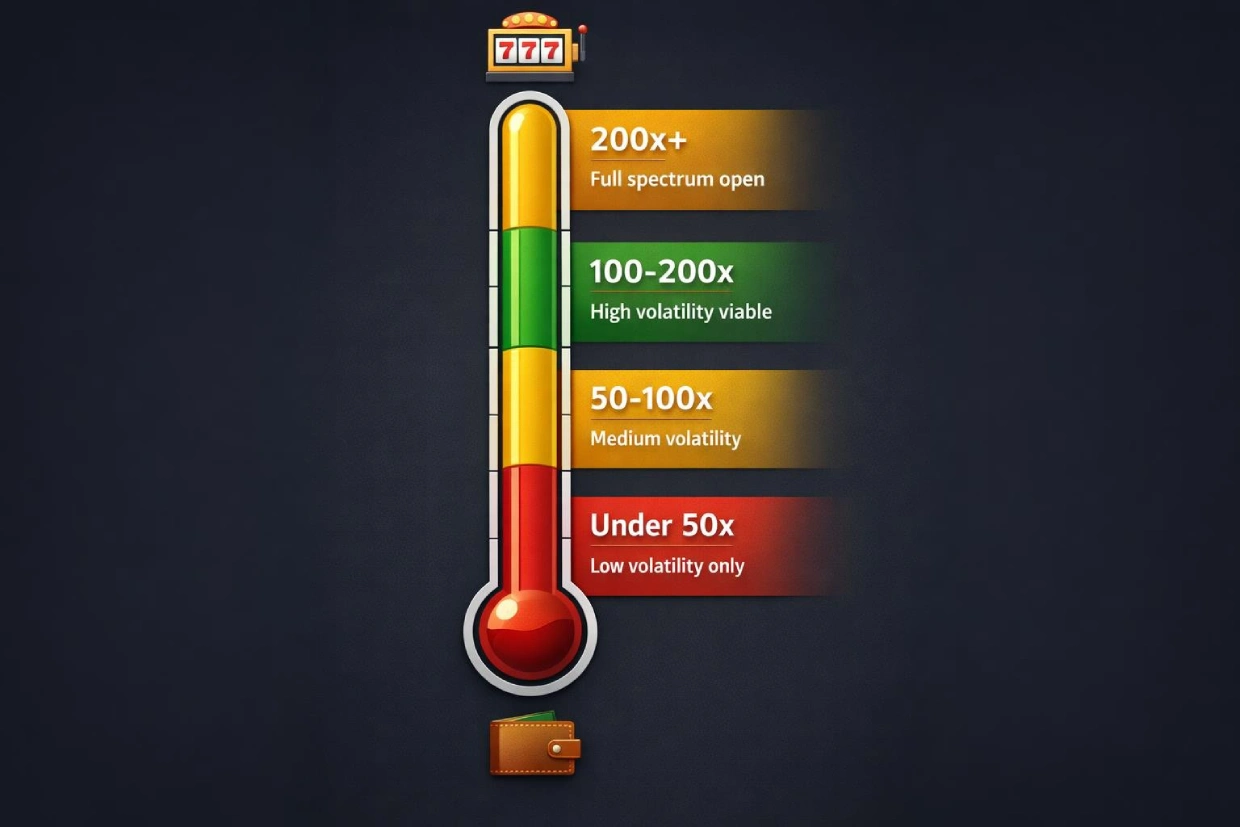
Before selecting a game, divide your session budget by your planned stake. That number is your budget-to-stake ratio.
- Under 50: Stick to low volatility. Your budget cannot absorb high-volatility dry stretches.
- 50-100: Medium volatility is comfortable. You have enough rounds to see some variance play out.
- 100-200: High volatility becomes viable. Your budget can survive extended losing periods.
- 200+: Full volatility spectrum is open to you. Choose based on preference, not survival.
This simple calculation removes the most common source of misaligned expectations in slot play: choosing a game your budget cannot support.
Slot Volatility FAQ
What is slot volatility?
Volatility measures how a slot’s returns are distributed across spins. Low volatility means frequent small wins. High volatility means rare large wins. It describes the risk and reward profile of the game.