
The UFC is the premier organisation in mixed martial arts and hosts the most watched combat sport events in the world. Every fight card brings together athletes from different martial arts backgrounds, and the unpredictability that comes from matching wrestlers against strikers, grapplers against kickboxers, and all-round fighters against specialists is what makes UFC betting one of the most analytically engaging markets in sports. Interest in UFC betting in India has grown steadily alongside the broader rise of combat sports viewership, and the weekend scheduling of most major events makes fight nights a consistent part of the betting calendar. This guide covers how UFC betting works, which markets are available, how to analyse fights before placing a wager, and how live betting operates during an event. It is part of Sports Betting Guides and covers the UFC betting markets available on SkyExchange. Bettors who also follow boxing will find the Boxing Betting Guide a useful companion, as many of the same analytical principles around fighter style, physical attributes, and method of victory apply across both combat sports.
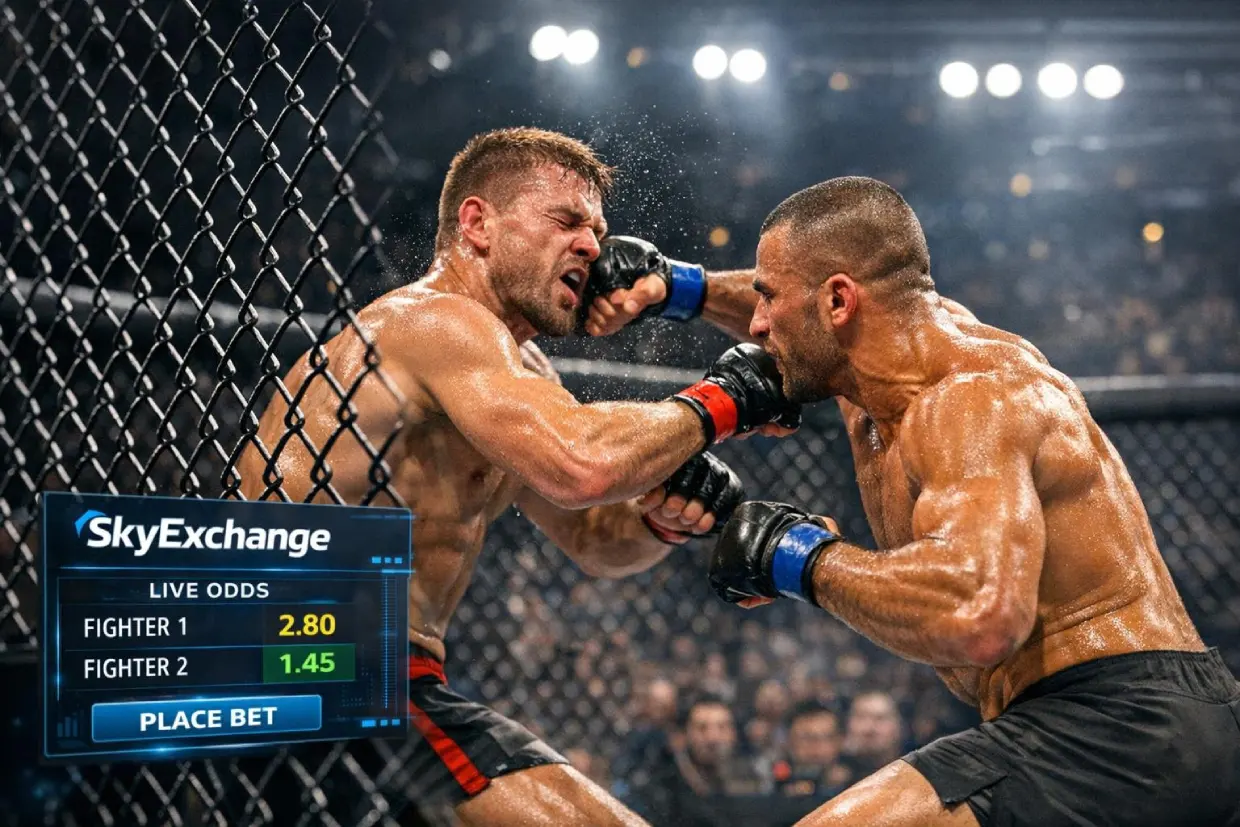
How UFC Betting Works
UFC betting is built around predicting outcomes in individual fights between two mixed martial artists. Unlike team sports where form and statistics relate to a collective, every UFC bet comes down to assessing two specific fighters and how their skills, styles, physical attributes, and current preparation are likely to interact inside the octagon. This makes fighter research the central activity of UFC betting, and bettors who invest time in understanding how specific fighters match up against specific opponents carry a genuine analytical advantage.
UFC events typically feature a main card of five fights and a preliminary card of additional bouts. The main event and co-main event attract the most market depth and the most widely available fighter information, making them the natural starting point for most UFC bettors. Undercard fights can offer value precisely because less information is priced into the market, but they require more specialist knowledge of the fighters involved to approach with confidence.
Understanding how UFC fights are decided is important before approaching any betting market. Fights can end by knockout, technical knockout, submission, or judges decision across three or five scheduled rounds. Each of these outcomes has its own betting market, and understanding which outcome is most likely in a given matchup requires knowledge of both fighters’ finishing rates, defensive skills, and how they perform when the fight goes to the later rounds.
Types of UFC Bets
UFC betting markets reflect the multiple ways a fight can end and the range of predictions that are possible within a single bout. Understanding what each market measures helps bettors choose the option that best fits their analysis.
Fight Winner
The fight winner market is the most straightforward UFC bet. Bettors predict which of the two fighters will win the bout by any method. Odds reflect the perceived skill gap between the two fighters, their recent form, and how well their styles are expected to match up. This market is the natural starting point for bettors new to UFC and the most liquid market available for every fight on the card.
Method of Victory
Method of victory betting asks bettors to predict not just who wins but how the fight ends. Common options include knockout or technical knockout, submission, and judges decision. This market carries higher odds than the straight fight winner because it requires an additional layer of prediction accuracy. Bettors who have a strong view on a fighter’s finishing ability, or on a matchup that seems likely to go to the scorecards, will find this market a natural extension of their fight winner analysis. A submission specialist facing an opponent with a weak ground game, or a powerful striker matched against a fighter with a history of getting knocked down, both suggest clear method of victory angles worth considering.
Total Rounds
Total rounds betting focuses on how long the fight will last rather than who wins. A line is set and bettors predict whether the fight will end before or after a specific round. Fights between two aggressive finishers with high knockout rates are more likely to end early, while technically sound fighters who excel at defensive work and pace management tend to push fights to later rounds or the final decision. Non-title fights are scheduled for three rounds and title fights for five, which affects how total rounds lines are set and how they should be approached.
Round Betting
Round betting requires predicting the specific round in which the fight will end, sometimes combined with which fighter wins in that round. The precision required makes this the highest-odds standard UFC market and the most difficult to approach without detailed knowledge of both fighters. Fighters with a history of starting slowly before finding their rhythm in later rounds, or those known for fading physically in championship rounds, can make round betting more approachable when a clear pattern exists in their previous performances.
Fight to Go the Distance
The fight to go the distance market asks bettors to predict whether the fight will reach the final scheduled round and be decided by the judges. This is a yes or no market that rewards bettors who have a clear view on whether both fighters have the defensive qualities and cardio to survive the full scheduled rounds or whether a finish is the more likely outcome.
UFC Betting Tips
UFC betting rewards deep fighter research more than almost any other sport. The combination of multiple possible outcomes, a wide range of fighting styles, and the physical unpredictability of combat means that surface-level analysis based on record and ranking alone is insufficient for consistently informed betting decisions.
Study Fighter Styles and Matchups
Style matchups are the most important analytical factor in UFC betting. A wrestler who consistently takes fights to the ground has a fundamentally different challenge against a Brazilian jiu-jitsu specialist than against a pure striker with limited grappling defence. A high-volume kickboxer who likes to control the centre of the octagon faces different problems against a pressure fighter who cuts off movement than against an outfighter who moves away. Understanding how two specific styles interact is the central task of UFC fight analysis and the factor that most consistently separates informed bettors from those relying on reputation or record alone.
Assess Recent Form and Activity
Recent fight history reveals current physical condition, confidence, and how a fighter has developed or declined since earlier in their career. A fighter coming off a dominant performance is a different proposition from one who survived a close decision or showed signs of physical decline in their last outing. The time since a fighter’s last bout is also relevant, as long layoffs can affect sharpness and ring timing regardless of how well a training camp has gone.
Consider Weight Class Dynamics
Different weight divisions in the UFC have distinct fighting characteristics that affect how markets behave. Lighter divisions typically feature higher striking volume, faster pace, and more back-and-forth exchanges. Heavier divisions produce more fight-ending power and often result in earlier finishes when a clean shot lands. Understanding the stylistic tendencies of the weight class a fight is taking place in adds context to method of victory and total rounds analysis.
Factor in Physical Attributes
Reach, height, and the quality of a fighter’s physical conditioning all influence how a fight is likely to unfold. A fighter with a significant reach advantage can control distance and land strikes while staying out of range of a shorter opponent. Conditioning becomes increasingly relevant in championship five-round fights where the ability to maintain output and technique in the fourth and fifth rounds separates elite fighters from those who fade under prolonged pressure.
Live UFC Betting
Live betting in UFC operates between rounds and during the fight itself as odds update in response to what is happening inside the octagon. Because a single exchange can change the dynamic of an entire fight, live UFC odds can move dramatically within seconds of a significant moment. A knockdown, a takedown, or a fighter taking visible damage all trigger immediate market adjustments.
The period between rounds is the most useful moment for live UFC betting. The corner advice given to each fighter, any visible physical damage such as cuts or swelling, and how the pace of the fight is developing all provide information that was not available before the opening bell. A fighter who is winning rounds comfortably but showing signs of fatigue early in the fight presents a different live betting scenario from one who is winning while still looking physically fresh. Watching the fight closely and assessing both fighters between rounds gives live bettors context that the updated odds alone cannot convey.
UFC Betting Odds
UFC betting odds express the probability assigned to each fighter winning and determine the return on a winning wager. Decimal odds are the most commonly used format. Odds of 1.55 return 1.55 units for every unit staked, while odds of 3.80 return nearly four times the stake on a winning bet. Heavy favourites in UFC often carry odds well below 1.50, reflecting a high implied probability of winning, while significant underdogs can carry odds of 4.00 or higher in mismatched bouts.
UFC odds are particularly sensitive to public perception around star fighters, which can create value on opponents who are more competitive than their odds suggest. Fighters with large followings attract heavy betting activity that pushes their odds lower than pure probability assessment would justify. Bettors who identify matchups where the favourite is overvalued by the market relative to the analytical reality of the stylistic contest can find consistent value in the underdog market across the UFC fight calendar.